
On stage last month at the University of Minnesota Transportation Research Conference, I had the immense pleasure to hear Alison Conway, a professor at The City College of New York, present, and her keynote was brilliant.
While it focused heavily on urban delivery and logistics, it was eye-opening to me for trucking operations too, bringing into focus something we’ve observed closely and acutely here at NTI over the past half-decade: The evolution of the driving job and its fragmentation into so many different buckets, roles, duties, and subsets.
The number of jobs we study has grown dramatically over the years, especially the past five to eight years, and the number of fleets coming to us for wage benchmarking data for nuanced, specialized, high-labor jobs has also ballooned. In fact, it’s become one of the primary staples of our research.
This ongoing transition was prompted by cascading changes in the way we as consumers procure food and goods, among other factors, but for our purposes, the point is that the way we think about drivers’ experiences in their jobs should be shifting and evolving alongside these ongoing transitions of the jobs we hire and retain for.

I shared the stage with Alison and former FMCSA Administrator Robin Hutcheson as we discussed how our supply chains are changing. My role was to help the audience take into the account the human element of transportation. Basically, answering the questions of what the seismic changes we’ve seen in recent years mean for our people, their work, their experiences in our industry and at our companies, and their satisfaction with their jobs. And vitally therefore, what are the takeaways and to-dos as we traverse the road ahead?
Our focus on drivers’ job satisfaction for so long has been on their driving experience; their equipment; traffic congestion; road conditions; detention at shippers and receivers; quality of the facilities at distribution centers; warehouses, docks; availability of parking; conditions of facilities at truck stops — you get the idea.
Those are themes we have explored in-depth at NTI, which you can find here:
Drivers on-road amenities: Would you use them?
Auditing your drivers’ experience at shippers’ facilities can strengthen relationships with both customers and drivers
Yes, many jobs at our fleets still are long-haul and regional work where those things absolutely do still matter and that we should be keenly focused on!
But for a large and growing number of driving jobs, there are so many other elements we need to consider when trying to understand and promote drivers’ satisfaction and safety in their job and with our companies.
Alison shared recent studies on changes in freight demand in New York and Pennsylvania, and her findings underscored something many fleets are now living: urban development rarely accounts for freight movement or the human beings moving that freight and, chiefly, stopping and parking in the middle of a busy, crowded city street to do the labor of loading and unloading.
Freight that used to be delivered into cities via a tractor trailer, parked in an alley and unloaded into restaurants, stores, or urban warehousing facilities, now arrives very differently, as do the drivers’ roles in those deliveries.
As an example, Alison used her own residential building, which receives — wait for it — 3,500 packages per day.
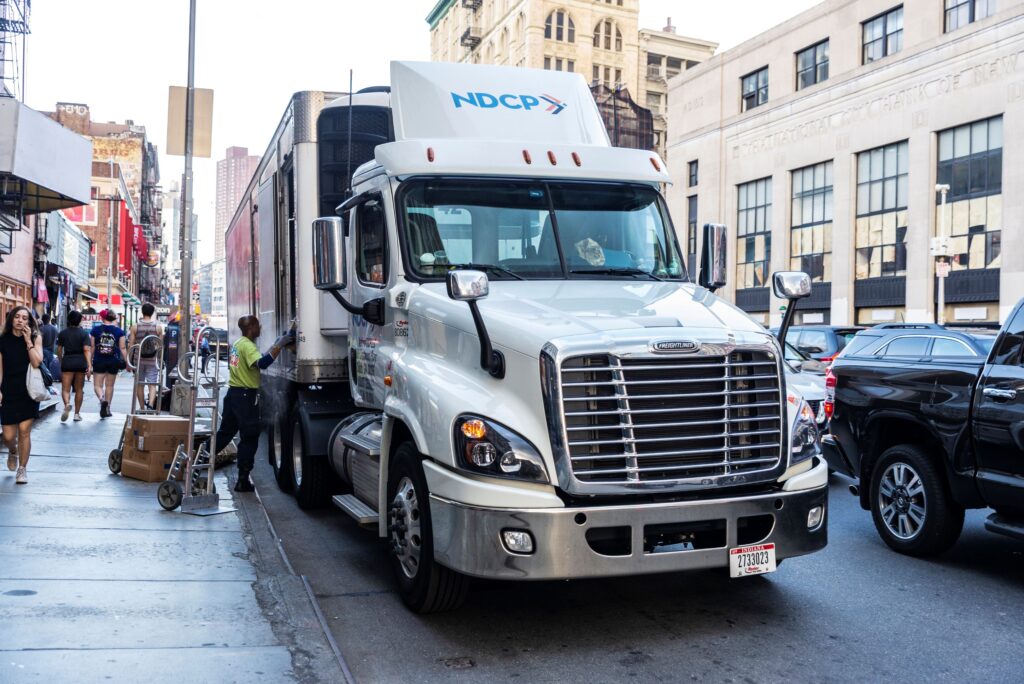
She said fully loaded tractor-trailers have been replaced by smaller vehicles that truck into New York from outside of the city and now act as what she called streetside “micro-warehouses,” where cargo is unloaded often onto the sidewalk for networks of even smaller vehicles to pickup: delivery vans and cars, bicycles with trailers, or even walkable wagons. Drivers have to stop in the middle of crowded streets, with pedestrians and traffic whirring by, and put themselves at risk while trying to lug freight at the same time. These jobs of course carry higher wages, but they also carry high labor, high risk, and high headache.
How many of your drivers do that type of work? I can tell you trucking companies, dedicated fleets, private fleets, and LTL carriers are all moving in the direction of what Alison called “proximity logistics.” More and smaller warehouses, shorter runs, smaller deliveries, and increased driver labor at both ends of shipping and receiving.
Cities of all sizes all over the country look like this, compounded by growing demand not only for parcel service from online retailers, but also their groceries, pharmacy orders, same-day orders from brick and mortars, orders of appliances or furniture fulfilled by local stores, and the myriad of other ways we buy and receive goods now. It’s also like this at stores across the country in suburban and exurban areas, where drivers often must hump individual cases of goods into stores or restaurants while dodging cars circling around a drive-through.
All of this was underscored recently by a post I saw on Facebook from a driver who made the switch from OTR to local. She highlighted what many of us think about and what many drivers believe about driving jobs when they’re hired, but offered a glimpse into what the job really is on the ground:
People hear local driver and think it’s easy. Home every night, light freight, short runs. Sounds perfect, right? WRONG. Here’s the reality nobody sees: Some days you open trailers and find pallets tipped over, cases busted open, cans rolling everywhere, shrink-wrap shredded, and products leaning like a building after an earthquake. Warehouses don’t properly wrap pallets. Heavy items are stacked on top of lighter freight. Fragile and glass mixed with bulky items. No real load balance or load boars. Freight thrown in like Tetris gone wrong.
And to top it off, she says, they deal with customers who are upset when something’s missing, stores questioning why unloading takes so long, and dispatchers wondering why they’re running behind. “We’re not just drivers. We’re warehouse workers, freight doctors, problem solvers, and load rescuers trying to get groceries on the shelves for your table tonight. The industry doesn’t move without us.”
As our fleets’ work evolves to meet shipper customers’ needs and consumers’ preferences, and our drivers’ jobs further fragment, we must take this into account when considering our drivers’ experience, their safety, and their satisfaction in these environments.
If we want to hire, retain, and support the drivers who make all of this possible, then the way we think about their experience must shift accordingly to expand our focus beyond DCs and docks and into the real, evolving world where drivers’ work takes place today and, increasingly, tomorrow.
Until next time, stay safe and well! ~Leah